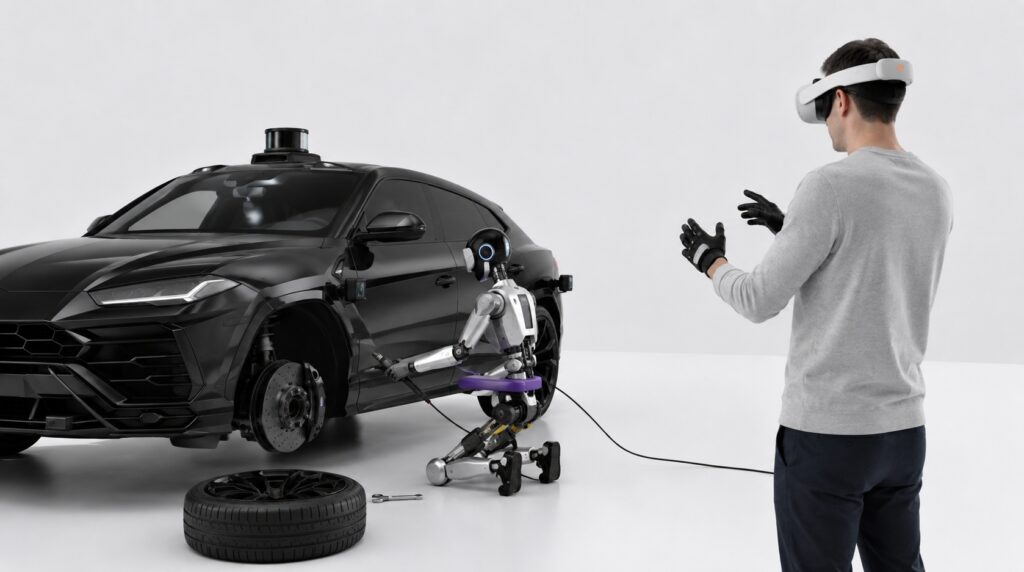
Our research spans robotics, XR teleoperation, autonomous aerial systems and autonomous driving combining high-fidelity simulation, AI training, synthetic data and real-world system integration.
We develop simulation environments for training and evaluating intelligent robots in complex physical environments. Our research combines physics-based simulation, reinforcement learning, synthetic data and AI perception to help robots learn through interaction.
We investigate how robots can develop physical intelligence by learning from simulated interactions with objects, environments and humans. This includes studying perception, manipulation, navigation and decision-making in realistic physics-based environments, with the aim of transferring learned behaviours from simulation to real robotic systems.

We research immersive teleoperation systems that allow humans to control robots naturally from remote or simulated environments. XR technologies provide the operator with spatial awareness while motion tracking and hand interfaces enable more intuitive control.
Our research explores how XR can create a natural interface between humans and robots. We investigate hand tracking, motion capture, spatial interfaces and haptic or visual feedback to improve dexterous manipulation and enable operators to control complex robotic systems with greater precision.
We develop simulation technologies for autonomous and remotely operated systems used in demanding environments. Virtual environments allow robotic platforms and autonomous systems to be tested across different terrain, weather and operational scenarios.
We research how simulation and immersive technologies can support the development of autonomous defense systems. This includes virtual mission environments, multi-agent simulation, sensor modelling, autonomous navigation and human-in-the-loop operation for testing complex scenarios in a controlled environment.
We research technologies for developing and validating autonomous and advanced driver-assistance systems in virtual environments. Our work combines realistic vehicle dynamics, physics-based sensor models and environmental simulation
Our research focuses on reproducing real-world conditions inside simulation, including sensor behaviour, weather effects, vehicle dynamics and complex traffic environments. We study how synthetic data and physics-based simulation can be used to train and validate perception and autonomous driving systems before real-world testing.